
Development Time
4 Weeks ~ Aprox. 125 hours
Team size
Individual
Technology
JavaScript, Node.js, socket.io, Phaser framework
synopsis
Speak is an experimental cooperative networked game in which players develop their own language through body language and the world around them. Teams of two work to translate an English dictionary into their own language.
Speak Gameplay
roles & Responsibilities
design
- Designed core dictionary matching mechanic and speaking mechanics
- Designed world map to help players discover word meaning
- Setdressed demo level with objects players use to help communicate meaning to each other
- Found inspiration in the concept of body language and context clues to reach understanding
programming
- Programmed player controls to sync smoothly across a network in 2 person lobbies
- Architected chat system to work across a network
- Architected dictionary system that reveals and hides certain information from certain players as needed
- Scripted design tools to help iterate level
- Programmed client side Ui functionality
Art
- Design and animated player characters
- Designed user interface
- Illustrated world objects for placement
Design Goals
- Crafting a truly cooperative puzzle
- Empowering players with non verbal communication
Crafting a truly cooperative puzzle

- One of the central challenges for players of Speak is defining the meaning of abstract symbols with a partner by only communicating in these same abstract symbols.
- Players have a dictionary in which they can plug in translations to English words using their library of symbols which they must agree on with their partner
- Agreeing on these translations involves listening to your teammate as they speak, gesture, and point.
- Unlike many puzzle games in which the mechanics serve as the obstacle to progress, in Speak teammates understanding of one another is what must be improved to win.
Empowering players with non verbal communication
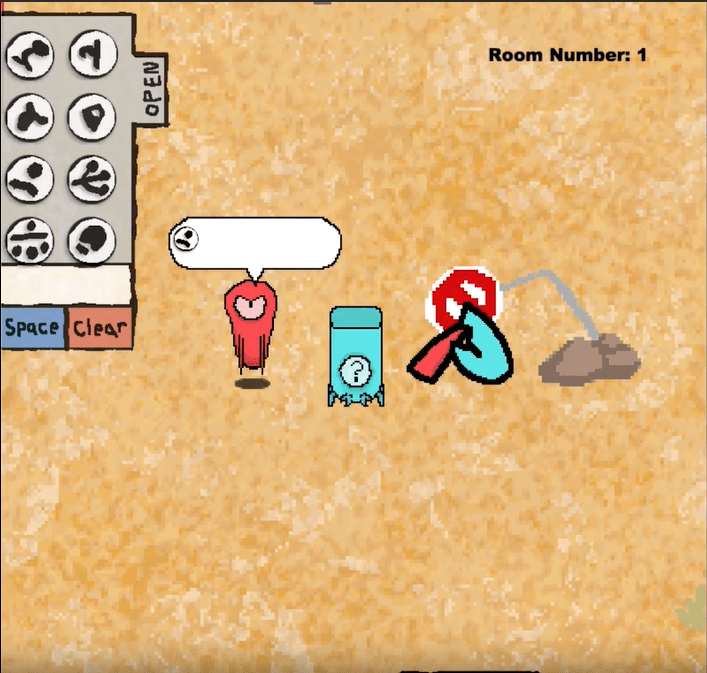
- Inspired by how humans really communicate, players in the game can present happiness, anger, confusion, shock, and sadness to their teammates.
- The addition of this feature drastically improved players ability to agree on symbol translations, especially when aided by the point feature.
- Players can place a pointer in the world for their teammate to see. Players use these pointers to get on the same page as their teammate, pointing to icons that can be defined through symbols.
- These two features, inspired by real communication patterns quickly became core to the rhythm of the game’s puzzles once implemented, improving player problem solving skills greatly.
Relationship between world design and puzzle challenges
| World Prop | Dictionary Entry That Can Be Derived |
| Do Not Enter Sign (seen in image) | Yes, No |
| Billboard With Human Face | Eye, I, Listen |
| Blue Box | Square, Blue |
| Wagon Wheel | Circle |
| Snake in Ampersand Shape | And |
 Austin Merritt