
Position
Lead Level Designer & Track and Environment Designer – SMU Guildhall
Development Time
15 Weeks ~ 225 Hours per Person
Team size
45 ~ 16 Level Designers
Technology
Unreal Engine 4
synopsis
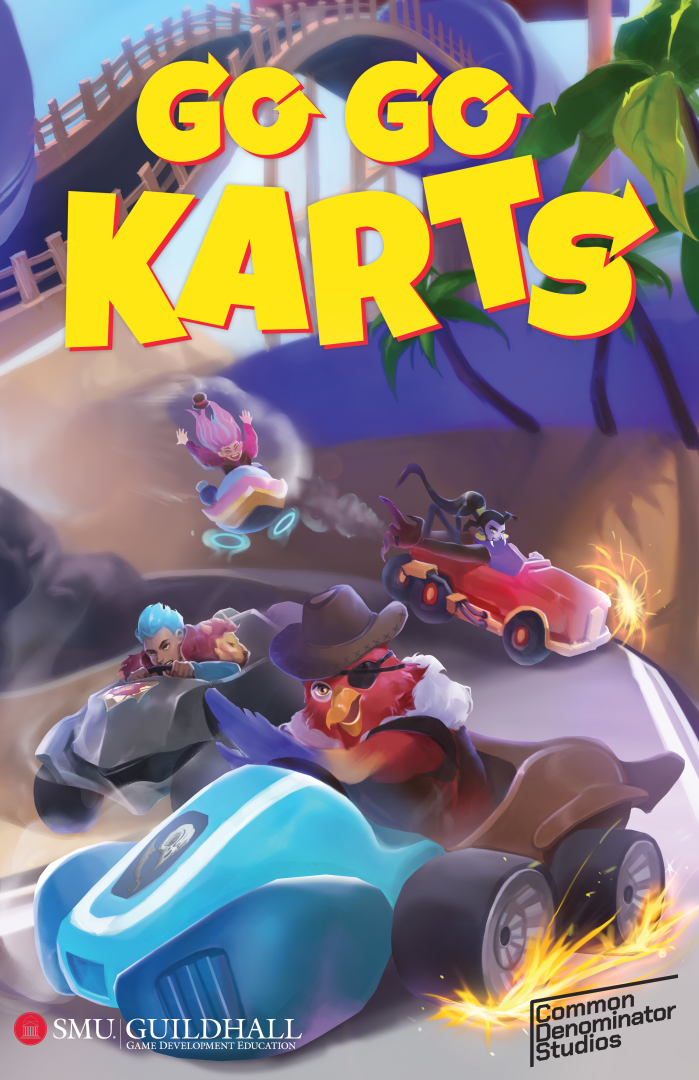
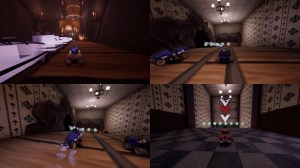
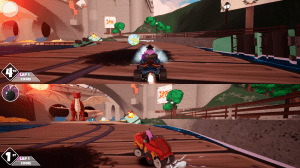
Go Go Karts is a local co-op kart racing game in the style of Mario Kart. Grand Prix featuring 3 tracks each set in one region of the game’s theme park. Includes both local multiplayer and single player races with AI opponents.
trailer
roles and Responsibilities
I served as the Lead Level Designer for Go Go Karts following promotion from my original position as a track designer.
- Accountable for the delivery of 3 racetracks supporting the vision of the game designer. Worked with all disciplines on a team of 45 students to ensure tracks promote the core racing experience of the game.
- Accountable for the world interactions and environmental design of each themed track.
- Responsible for designing 4 track obstacle tools with programmers to be used by the track team.
- Responsible for developing the modular track pipeline tools with artists at the start of the project.
- Responsible for set dressing on each of the game’s tracks.
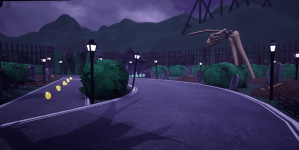
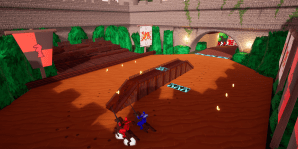
Marketing screenshots



design Goals
- Balancing the Haunted Coaster
- Placing Competitive AI Splines
- Limiting the Frustration of the Kraken
- Keeping Players on the Dragon Coaster
- Maximize Use of Setdressing Assets
balancing the haunted Coaster

Ghost Coaster Spline 
View on Ghost Coaster 
Roller Coaster Obstacle Final Implimentation 
Yellow: Coaster Trains | Green: Item Boxes | Blue: Player Path 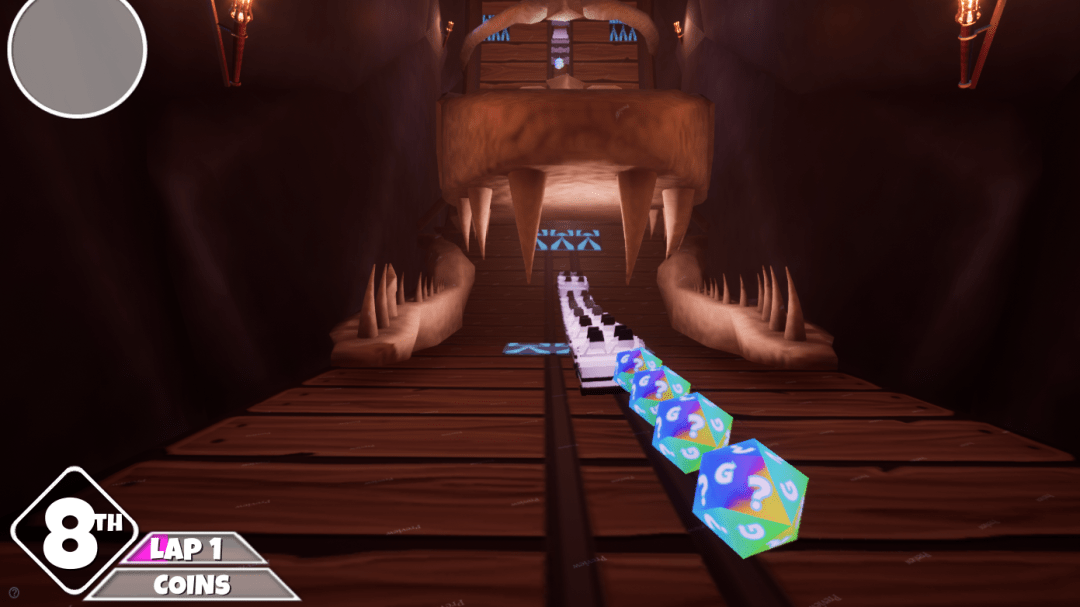
Start of Ghost Coaster
- The goal for the roller coast obstacle was to challenge the players with dodging roller coaster trains without frustration them with a lack of information.
- Item boxes were attached to the coaster to encourage more risk and reward.
- After many iterations of the obstacle an interval spawning system was implemented.
- When a player in 1st-3rd comes to the roller coaster it launched before going on a cool down , likely to spawn again for players in 4th-6th.
- Because the coaster is intentionally slower than the players all players are likely to experience the coaster in a consistent way each lap
placing competitive ai splines

Garden Shortcut 
Twisting Forest 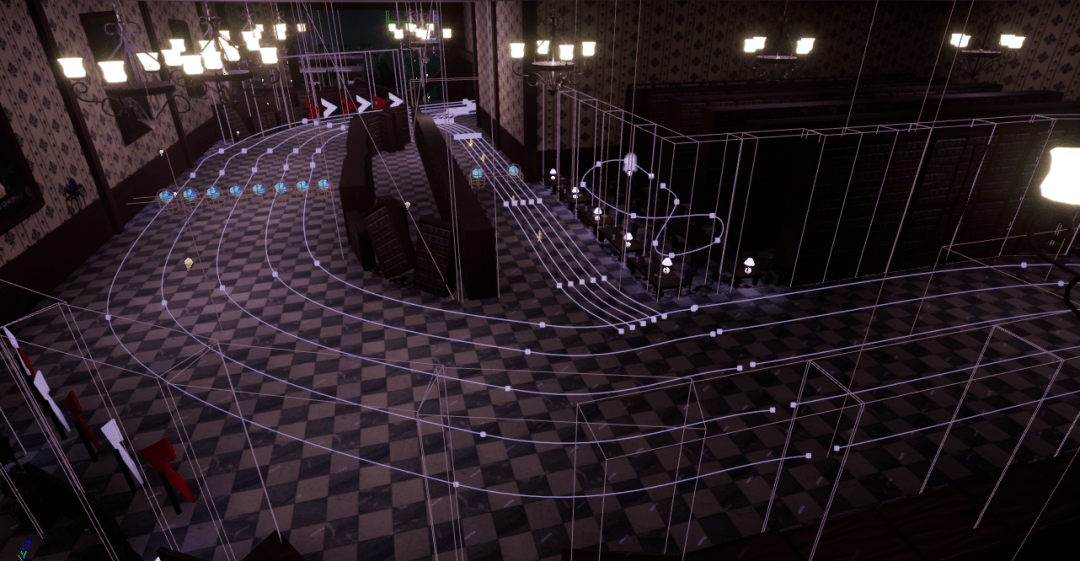
Mansion Shortcut 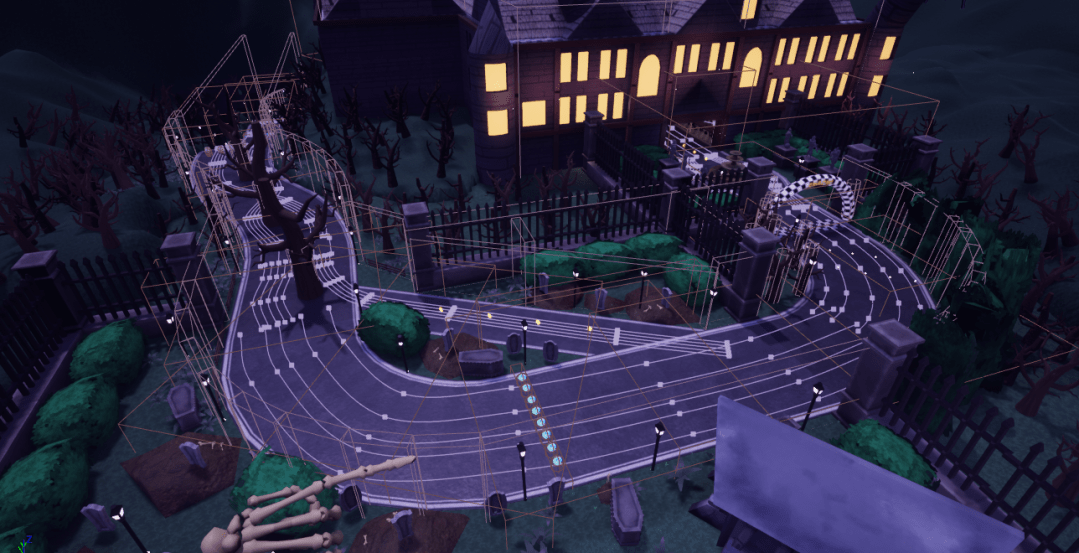
Mansion Exterior In Engine
- Using a programmer made spline tool, nodes were placed around the Haunted Track for the AI to follow
- Ensuring AI were competitive demanded they could access shortcuts and avoid obstacles, both elements having to be considered when placing the AI spline within the track
- Shortcuts could be implemented by attaching a new spline to the existing critical path at the start and end of the shortcut
- Spline nodes could be placed in such a way to assist the AI in avoiding certain obstacles such as trees or fountains
- Splines had to be assembled with the skills of the AI in mind ensuring the critical path was wide enough to allow them choices but guided enough to avoid them getting stuck
limiting the frustration of the kraken

View of Racers near Obstacle 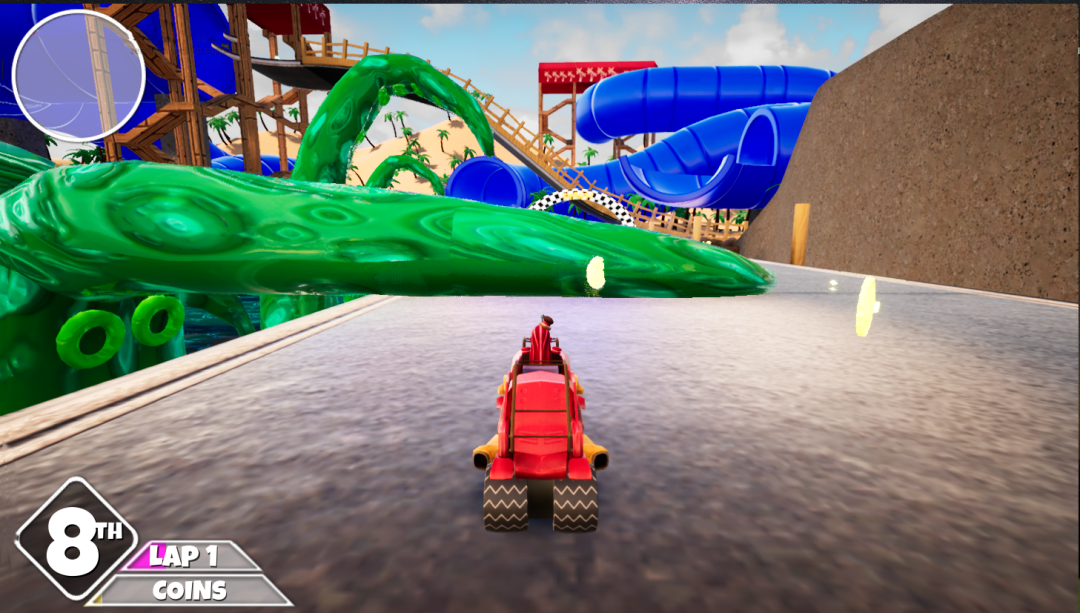
Player View of Obstacle 
Kraken Obstacle Final Implementation 
Red: Tentacle Arc | Yellow: Item Boxes | Orange: Moved Tentacles
- The goal for the Kraken obstacle was to challenge players with dodging large tentacles that swipe drivers off the track right before the finish line.
- Initially organized in sets of two, the animation and position of the swiping kraken arms meant that players could never dodge both sets of arms.
- The first attempt at fixing this caused the players to get hit by the kraken before the race even began. The track team moved these arms away from the track (orange) instead of deleting them to match the kraken head mesh.
- The next piece of the solution involved pulling the arms back to only hit half of the track and place a series of item boxes on that side of the road. Doing this gave players a safe way to make it through this section but also enticed them to take a risk for the items.
Design goal: keeping players on the Dragon coaster
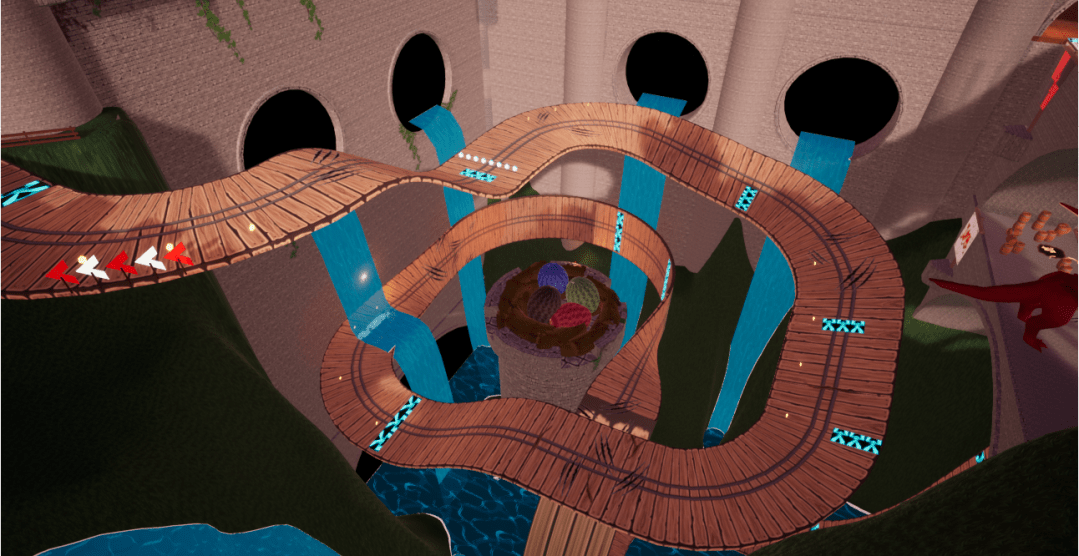
Dragon Coaster Full View 
Dragon Coaster Final Implementation 
Boost pad moved back to keep players on track during corkscrew 
Player View of Obstacle
- The dragon coaster section of the medieval track was intended to be a difficult area to navigate due to its high speed and lack of walls.
- Players were simply going too fast to keep their karts on the tracks during corkscrews. Many of the potential solutions to this problem were off limits because the tracks were unable to be edited and the kart metrics were locked.
- Using playtest data, boost pads were strategically moved along the track to slow the players down at the right spots.
- It was quickly discovered that moving one boost pad has a domino effect on the other boost pads nearby required repeated testing to ensure the track still captured the intended sense of danger without being impossible to stay on.
maximize use of environmental assets

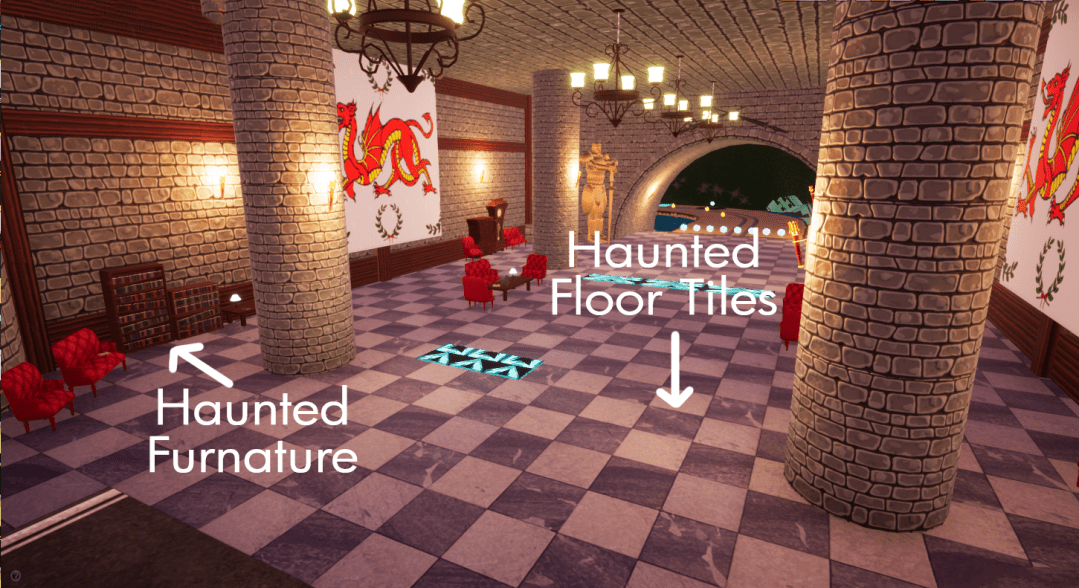
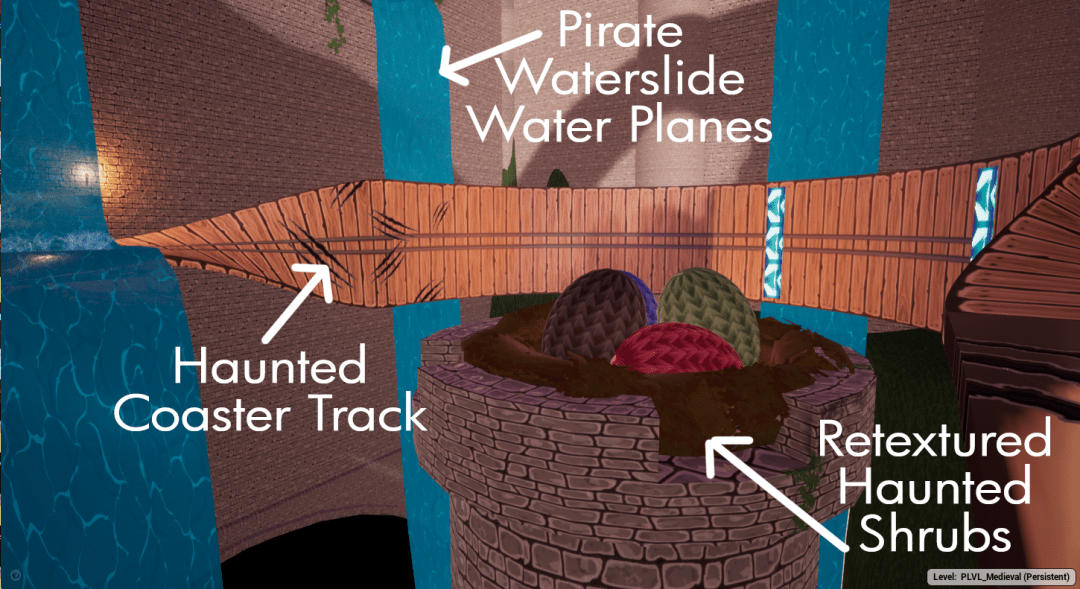
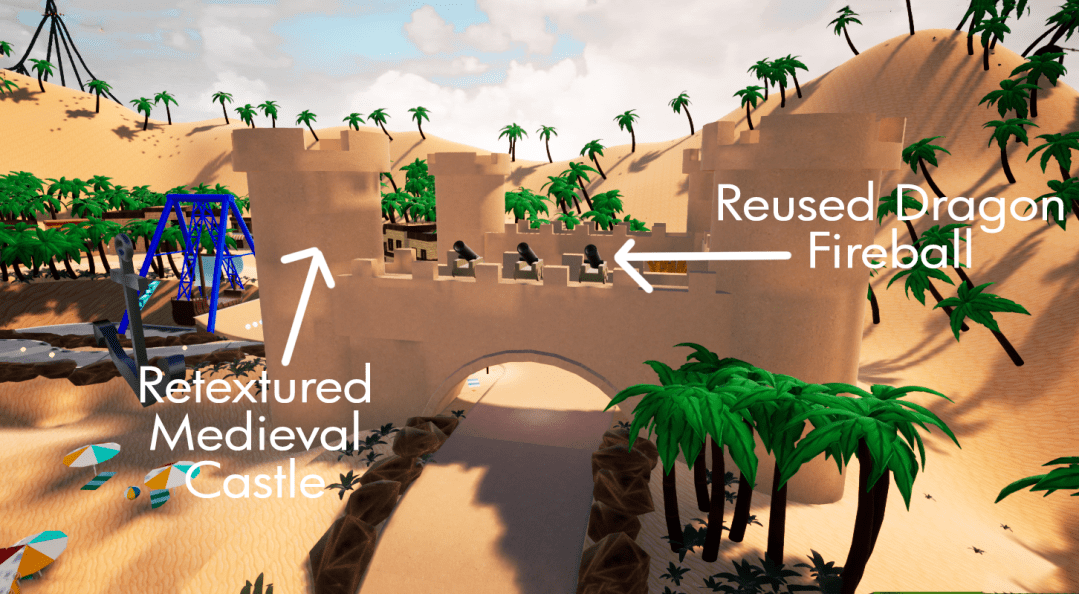
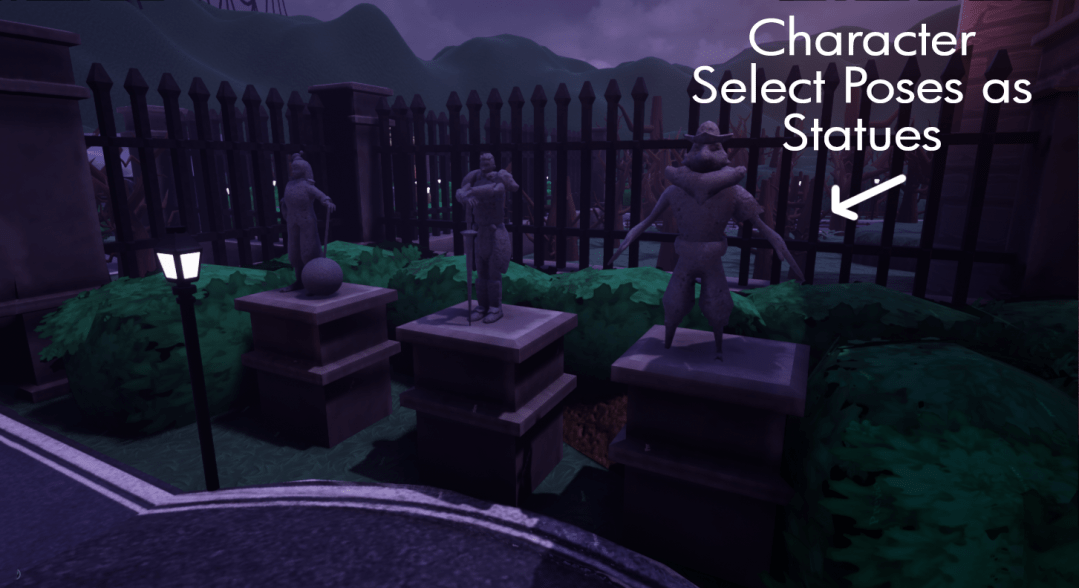
- The goal for Go Go-Karts was to have 3 distinctly themed tracks at release but with our schedule this proved to be a problem
- Much of the work of the lead level designer in later milestones involved determining how to fill out each level without asking for more assets from the art team.
- The solution for this problem was to design unique thematic set pieces assembled from non unique assets.
- The sand retexture of the castle mod kit seemed a natural addition to the pirate level standing out as a strong landmark around the last section of the track fitting in well with the recycled dragon fire obstacle as cannon balls.
- Various statues throughout the game were built using the posed rigs from the character select screen
- The medieval track was the last to reach alpha ready meaning much of its visual identity and storytelling had to be cleverly constructed from elements from the previous two tracks such as the decimated dragon coaster as well as the castle interiors.
Post Mortem
what went well
- Working with programmers to design and iterate thematic track obstacle
- Communication with my designers and artists consistently improved throughout the project.
- Learning the strengths of each of my teammates and giving out tasks to match
- Focusing on setting up a modular track kit pipeline with artists allowing the track team to create unique feeling tracks quickly.
what went wrong
- A divide between the artists and level designers on the track team I was unable to bridge Level designers ended up designing around the art assets they were given while artists felt their assets were unreasonably being changed to fit designs.
- I sometimes abandoned planning and pipelines when the stress began to build towards the end of the project and assembled my own strike teams to get tasks done
What I learned
- As a lead I could have better communicated design changes to the rest of the team to reduce confusion.
- Asking my team questions about their understanding of our goals and how they plan to tackle them is more effective than waiting for questions to resolve.
- Encouraging teams that tend to work in isolation to communicate more with each other should have also been a more consistent practice as a lead
- Some pipelines became outdated and irrelevant while others were followed but inefficient. I recognizing these issues should have reevaluated our pipelines and gotten the team input on where to improve them during every major milestone.
 Austin Merritt